
How to Know If Your Locks Are Insurance Approved: A Practical Guide
What if a lock that looks secure still doesn’t meet your insurer’s requirements? To understand how to know if locks are insurance approved, start with the wording of your own policy, not the lock’s appearance. Insurers can specify different requirements, so a lock that suits one property may not satisfy another policy.
It’s understandable to feel unsure. Policy terms can be hard to interpret, and markings on a lock aren’t always easy to spot. The distinction matters: a BS 3621 mortice lock and a TS007-rated euro cylinder apply to different lock types. Checking the wording and identifying what’s fitted can help you see whether there’s a mismatch before it becomes a concern during a claim.
This guide explains where to find the relevant security conditions, how to identify locks on the doors your policy covers, and what to do if a requirement is unclear or unmet. You’ll also learn when a locksmith assessment can help identify existing locks and consider an appropriate upgrade, without replacing anything unnecessarily.
Key Takeaways
- To understand how to know if locks are insurance approved, locate the security conditions in your current policy and note which doors they cover.
- Use lock markings, packaging and installation paperwork to help identify what’s fitted, but match any markings to supporting evidence.
- Make a door-by-door record of the locks in your home, then compare each one with the policy wording.
- If the lock identity or policy requirement is unclear, a locksmith assessment can help clarify what is fitted.
- Consider an upgrade only if an existing lock doesn’t meet your insurer’s stated requirements.
How to know if your locks are insurance approved: start with your policy
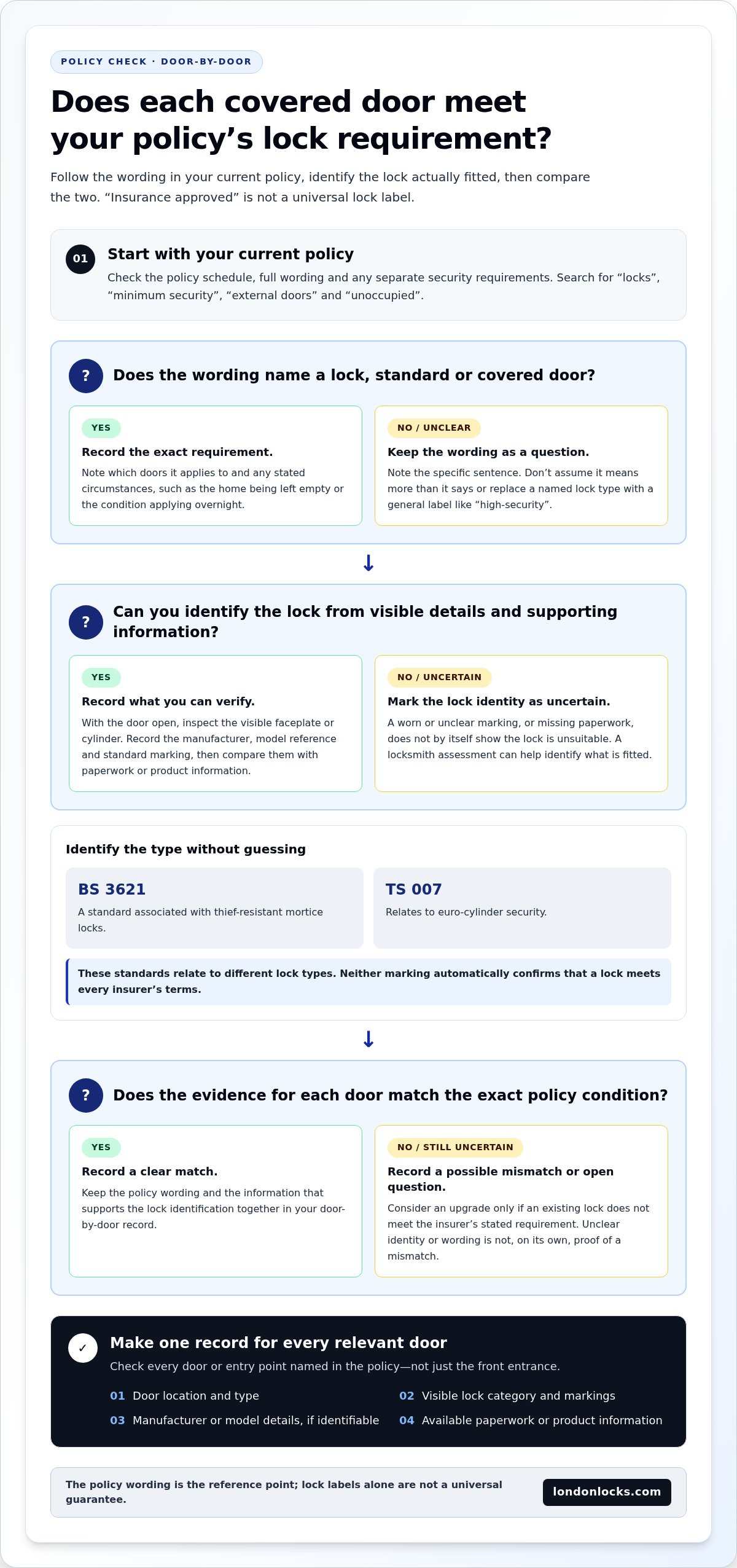
The quickest way to establish what your insurer expects is to read the current policy documents. Look at your buildings and contents cover, including the policy schedule, full wording and any separate security requirements. Search for terms such as “locks”, “minimum security”, “external doors” and “unoccupied”. Don’t rely on an old renewal document if your cover has since changed.
Where to find lock requirements in a home insurance policy
Check the exact scope of each condition. It may refer to all external doors, name a particular entrance, or apply only in certain circumstances. Read the surrounding sentences, too: a requirement could depend on whether the home is left empty, or whether the condition applies overnight. These details can change how you interpret a clause.
Copy any named lock type or standard exactly as it appears. Don’t assume a clause means more than it says. For example, if your policy names a particular lock type, record that wording rather than replacing it with a general description such as “high-security lock”. If the language is unclear, make a note of the specific sentence so you can resolve that point before drawing conclusions.
Why ‘insurance approved’ is not a universal lock label
Insurers can set different security conditions, so there isn’t one label that automatically confirms a lock meets every policy. Approval means meeting the specific conditions in your own policy, not receiving a universal guarantee that a lock will satisfy every insurer. That distinction is central to how to know if locks are insurance approved.
A product description or label may help you identify a lock, but it can’t establish by itself that the lock matches your policy. The policy might specify a standard, a lock type, or the doors to which a condition applies. You need to compare the product information with that precise wording, rather than treating “insurance approved” as a blanket promise.
If your documents refer to a deadbolt, first make sure you understand the term being used. This overview of deadbolt locks provides general background, but it doesn’t determine what your insurer requires. Keep the policy clause as your reference point. A clear record of the wording gives you a reliable basis for checking the locks fitted around your home in the next step.
Identify your fitted lock by its type, markings and documents
Once you’ve found the relevant condition, identify what’s actually fitted to each door. Start with a visual inspection, not a screwdriver. With the door open, look along the edge for the lock faceplate and any visible manufacturer name, model reference or standard marking. On a uPVC or composite door, note the visible cylinder and handle. Take clear photos and record the wording exactly. Don’t remove the cylinder or dismantle the lock to search for a label.
What lock markings and paperwork can tell you
A marking can provide a useful lead, but it needs to match reliable product information. Check installation paperwork, packaging or product documents for the same manufacturer and model reference, then compare those details with the manufacturer’s information. A standard marking may help identify a lock, but don’t assume a partial or unclear mark proves compliance. Missing paperwork doesn’t, by itself, show that a lock is unsuitable; it simply leaves its identity less certain.
Recognise common lock categories without guessing
A five-lever mortice lock sits inside the door, with its faceplate visible along the door edge. A euro-profile cylinder is a separate key-operated component, commonly fitted through the centre of a multipoint door lock. BS 3621 is a standard associated with thief-resistant mortice locks; TS 007 relates to euro-cylinder security. These names help narrow down what you’re looking at, but neither label automatically confirms that a lock meets every insurer’s terms.
Keep a simple record for each door. This will make it easier to compare the evidence with the exact requirement later.
- Door location and type
- Visible lock category and markings
- Manufacturer or model details, if identifiable
- Available paperwork or product information
If the mark is worn, hidden or difficult to interpret, don’t guess from the key shape or handle alone. A locksmith can assess the fitted lock and help identify its type. That gives you a clearer basis for checking how to know if locks are insurance approved, without replacing a lock simply because its paperwork is missing. If a replacement is appropriate, explore lock fitting and upgrades based on the requirement you need to meet.
Confirm the match: compare each door with the policy conditions
Now bring the policy wording and your lock notes together. Check every door or entry point named in the policy, not just the front door. Requirements can differ across a property, and one lock’s markings don’t establish what’s fitted elsewhere.
A practical door-by-door checking method
Make a separate entry for each relevant door. Include its location, the lock type you identified, any visible markings and the paperwork or product information that supports that identification. Then compare each entry with the exact condition in your policy. Mark a clear match, a possible mismatch or a question that still needs an answer.
- Front entrance: record the fitted lock and evidence.
- Rear or side entrance: check separately if the policy condition covers it.
- Other named doors or entry points: include each one the wording specifies.
For example, if a clause names a lock type for external doors, compare that condition with the evidence for each covered door. Don’t treat a similar-looking lock or a matching front-door lock as proof for the rest of the property. Keep photographs and relevant documents with your notes so you can refer to specific details if you need clarification.
For each entry, record the policy condition, the door, the fitted lock and the supporting evidence. This simple format makes it easier to spot what you’ve verified and what remains uncertain. It’s a practical step in how to know if locks are insurance approved for your home.
What to do when the policy or lock details are unclear
If a condition could be read in more than one way, ask your insurer to explain that specific clause and what evidence it needs to assess the requirement. Keep the answer with your policy documents. If you can’t identify a lock confidently from its markings or paperwork, a locksmith can assess it; an upgrade is an option only if the existing lock doesn’t meet the stated condition.
Unfamiliar terms can make the comparison harder. The lock and security glossary can help explain common terminology. For broader property-security context, London Locks – Locksmiths Keys and Fobs. also has a home security advice guide.
Arrange a lock assessment or discuss a suitable upgrade
When a locksmith assessment or lock upgrade can help in London
A locksmith assessment can help if you can’t identify a fitted lock, its markings are unclear or you need to understand how it relates to a condition in your policy. It gives you a clearer view of what’s installed and whether further action may be needed. An assessment doesn’t mean every lock should be replaced. Any recommendation should depend on the lock and the requirement you’re trying to meet.
What a locksmith can assess before recommending an upgrade
A locksmith can identify the lock type, examine visible markings and explain what they mean in plain English. Share the exact policy condition so the discussion stays focused on your circumstances, not a one-size-fits-all claim. If an upgrade is appropriate, ask for a clear explanation of the proposed work and a fixed quote before agreeing to it. That kind of transparent process helps you make an informed choice and avoid pressure or unexpected charges.
London Locks – Locksmiths Keys and Fobs. is based in Bow and is an approved member of the Master Locksmiths Association. Its locksmiths provide lock fitting and upgrades. A replacement may be considered if the existing lock doesn’t meet the requirement you’ve identified, but there’s no need to change a lock solely because its paperwork is missing if its identity and suitability can be assessed.
How to take the next step with a London locksmith
Have the relevant policy wording, your door-by-door notes, clear photos and any lock paperwork ready. Point out the specific clause you’re trying to match. This helps keep the assessment practical and lets the locksmith explain the lock and your options against the information you’ve gathered.
London Locks – Locksmiths Keys and Fobs. is at 143 Bow Road, London, E3 2AN. Its master locksmiths have appeared on BBC TV features including Rogue Traders, BBC investigative features, Morning TV and Rip Off Britain. You can also find locksmith information on its YouTube channel. A professional assessment can help you understand what’s fitted before you decide whether any work is needed.
Arrange help with lock fitting and upgrades
Take the next step with confidence
Uncertainty doesn’t mean you need to replace a lock straight away. If a policy condition still feels unclear, make that the focus of your next conversation. A professional assessment can help identify what’s fitted and explain options in relation to the requirement you’re trying to meet. The aim is a clear decision, not unnecessary work.
For homeowners in Tower Hamlets, London Locks – Locksmiths Keys and Fobs. states it is the area’s only approved master locksmiths. The business is also an ABS and EVVA super centre for high-security locks and key cutting, giving you a local point of reference as you consider your next step.
If you’re still asking how to know if locks are insurance approved, take your policy wording and lock details to a professional assessment. A clearer understanding of your options can help you move forward calmly and protect your home with confidence.
Frequently Asked Questions
Can an insurer require a particular type of lock?
Yes, an insurer can specify a lock type or security condition, but the requirement depends on your policy wording and the circumstances it describes. A clause may apply to certain doors or only in particular situations, so don’t assume it applies throughout the property. Read the exact clause and ask your insurer to explain any ambiguous terms, including which doors it covers and what evidence it needs.
Is a BS 3621 lock automatically insurance approved?
No. A BS 3621 marking can be relevant evidence, but it doesn’t by itself prove that the fitted lock meets your insurer’s condition. To know if locks are insurance approved, match the identified lock and the door it secures against the policy’s exact wording. Check that the marking relates to the fitted model, not just packaging for a previous lock. If the clause is unclear, ask your insurer how it applies.
Does ‘insurance approved’ mean a lock is burglar-proof?
No lock makes a property impossible to break into. “Insurance approved” may describe a lock or refer to conditions set by an insurer, but it isn’t an absolute promise of protection. Security also depends on the policy’s scope and the property’s entry points, not a label alone. Treat the phrase as a prompt to check the details, and be cautious of any claim that a lock makes burglary impossible.
Do renters need permission to change a lock?
Renters should check their tenancy agreement and speak with the landlord or managing agent before changing a lock or other door hardware. This gives everyone a chance to agree how access, keys and existing arrangements will be handled. The property’s insurance conditions still matter, so establish which requirements apply before choosing a replacement. Don’t assume permission or restrictions are identical across tenancies; use the documents for your specific home.
Can I check whether a lock is insurance approved without removing it?
Yes. Start with visible markings on the lock faceplate and cylinder, then look for a model reference in installation paperwork, packaging or product records. Take a clear, well-lit photo to help with identification. Don’t remove the cylinder or dismantle the mechanism to find a marking. If the model remains unfamiliar, a locksmith can identify it; appearance alone can’t confirm that it meets your policy.
Disclaimer
Article written with assistance of AI – any content herein may not share the views or opinions of the company. Please contact the company directly for clarity on any issues with content.