

Change Locks After Moving House London: The 2026 Security Guide
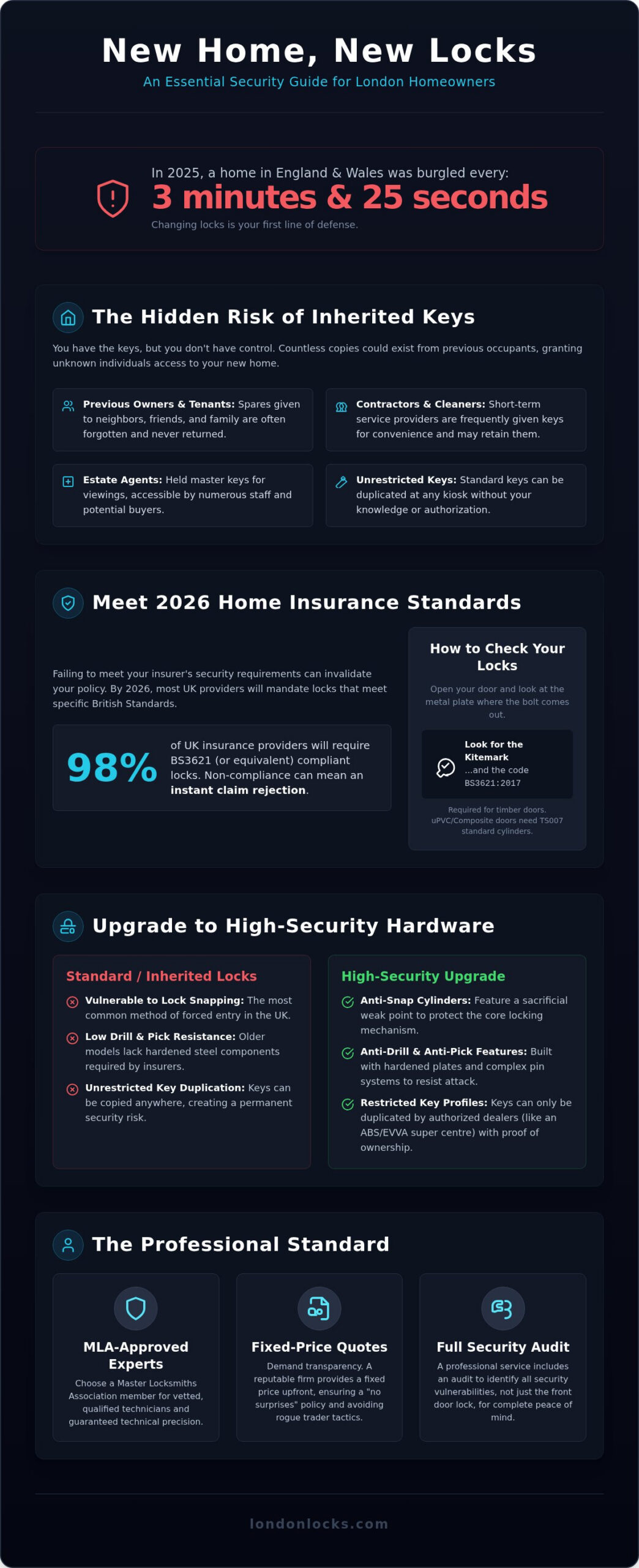
In 2025, a home in England and Wales was burgled every 3 minutes and 25 seconds. That is a chilling thought when you have just picked up the keys to your new property. You have the keys in your hand, but you have no idea how many copies were made by previous tenants, cleaners, or contractors over the years. To protect your family and your investment, the decision to change locks after moving house London is not just a suggestion; it’s an immediate security priority.
We understand that moving is already one of life’s most stressful events. You want to feel safe in your new home without worrying about uninvited guests or insurance loopholes. This guide will show you exactly why new locks are a non-negotiable step for every London homeowner. You’ll discover how to meet the strict 2026 insurance standards, including BS3621 and TS007 requirements. We’ll also reveal how to identify a reputable MLA-approved locksmith so you can get a fixed-price quote without the fear of hidden costs or rogue trader tactics.
Key Takeaways
- Eliminate the spare key risk. Changing locks is the only way to ensure previous owners or contractors no longer have access to your property.
- Stay insurance compliant. Learn why BS3621 and TS007 standards are non-negotiable for UK home insurance policies in 2026.
- Upgrade to high-security hardware. Discover the benefits of anti-snap cylinders and restricted key profiles that prevent unauthorized duplication.
- Prepare for professional installation. Use our door audit guide to identify whether you have timber, uPVC, or composite doors before booking.
- Secure your property with confidence. Choosing an MLA-approved expert to change locks after moving house London guarantees fixed pricing and technical precision.
Why Changing Your Locks is the First Step After Moving House
Moving day is a whirlwind of boxes and paperwork. Amidst the chaos, security often slips down the priority list. This is a dangerous mistake. You’ve just inherited a set of keys, but you haven’t inherited the security that should come with them. To truly secure your perimeter, you must change locks after moving house London. It’s the only way to be certain that your front door is actually locked to everyone but your family.
We see it every day across East London. Homeowners assume that “handing over the keys” at completion means they have total control. It doesn’t. A physical key is a liability the moment it leaves your sight. We provide fixed quotes for immediate lock upgrades to eliminate this uncertainty from your first night in a new property.
The Hidden Risks of Inherited Keys
Think about how many people might have held a key to your new front door over the last five years. Previous owners often hand out spares to neighbors, cleaners, or local tradespeople. Estate agents hold sets for viewings, and former tenants might have kept a “just in case” copy. While most people are honest, you cannot account for every duplicate in circulation. In a dense metropolitan area like London, the risk of unauthorized entry using a forgotten key is a statistical reality you shouldn’t ignore.
Even new builds are not exempt from this security recommendation. During construction, dozens of contractors and site managers have access to master keys. If your new home uses a standard Pin tumbler lock, it’s remarkably easy for a key to be copied at a local booth without any authorization. Upgrading to a restricted key profile from an ABS and EVVA super centre ensures that no one can duplicate your keys without your express permission.
Peace of Mind vs. Potential Intrusion
There is a massive psychological benefit to a fresh start. When we perform a lock fitting, we remove the “what if” from your mind. You aren’t just buying hardware; you’re buying the certainty that you are the sole gatekeeper of your home. Moving day is the ideal time for a full security audit to identify vulnerabilities before they become emergencies.
Many customers ask about “rekeying” versus a full “lock change.” In a residential context, changing the lock cylinder is the standard, most effective route. It’s fast, efficient, and allows you to upgrade to insurance-approved standards immediately. Key Control is the absolute knowledge of every physical key in existence for a property.
Our team at 143 Bow Road operates with total transparency. We don’t believe in hidden fees or “rogue” pricing. We provide the technical expertise of a master locksmith with the approachability of a trusted neighbor, ensuring your new London home is secure from day one.
Meeting London Insurance Requirements: BS3621 and Security Standards
Insurance policy fine print is the last thing you want to read after a burglary. In 2026, 98% of UK insurance providers require locks to meet the BS3621 standard for timber doors. If your locks don’t comply, your claim could be rejected instantly. This makes the decision to change locks after moving house London a matter of financial survival. You aren’t just protecting your belongings; you’re protecting your right to a payout if the worst happens.
Identification is simple. Open your door and check the metal faceplate. You need to see the engraved British Standard Kitemark, a heart-shaped symbol, alongside the code BS3621:2017. If that mark is missing, your lock is likely an older model that lacks the anti-pick and anti-drill features required by modern underwriters. Many residents forget to change locks after moving house London until they review their policy weeks later, leaving them vulnerable in the meantime.
A common mistake is relying solely on a night latch. While convenient, these “Yale-style” locks are often considered secondary security. Most insurance policies require a 5-lever mortice deadlock to be fully engaged whenever the property is empty. If you leave your home and only pull the door shut on the latch, you’re effectively uninsured. We see many homeowners in East London relying on outdated hardware that wouldn’t stand up to a five-minute attack.
Decoding British Standard BS3621
The 5-lever mortice deadlock is the gold standard for timber doors. It features hardened steel plates to prevent drilling and specialized levers to stop picking. It’s built to withstand a sustained physical attack. If you’re worried about the price of an upgrade, we offer total transparency. You can view our London locksmith pricing and transparency guide to see how we handle fixed quotes without hidden fees.
Security for London Flats and HMOs
Flats and HMOs require a specific balance between security and fire safety. You must be able to exit without a key in an emergency. We install insurance-approved thumbturn cylinders that meet both the BS3621 standard and fire regulations. For uPVC or composite doors, we focus on TS007 anti-snap cylinders to prevent the “lock snapping” technique used in many forced entries. Check our specific advice on fire safe locks for flats and HMO properties in London to ensure your property is compliant.
Not sure if your hardware is up to scratch? Book a professional lock fitting to bring your property up to 2026 security standards today.
Choosing the Right Hardware: From Standard Cylinders to High-Security Systems
When you change locks after moving house London, don’t just swap like-for-like. Most off-the-shelf cylinders are vulnerable to “lock snapping.” This technique is a significant concern for homeowners, widely exploited by burglars in urban areas across the UK, and London properties are certainly not exempt. This highlights the importance of upgrading your security. To properly change locks after moving house London, you need to upgrade to hardware that stays ahead of modern burglary methods. We recommend systems that combine physical strength with restricted access.
Restricted key profiles are a game changer for residential security. Unlike standard keys, these cannot be copied at a typical high-street booth. You must provide proof of ownership at an authorized centre to get a duplicate. This prevents former tenants or tradespeople from making “ghost copies” of your keys. We are a dedicated high security key cutting facility, ensuring you maintain total control over who holds a key to your property.
Smart locks are another option for your new move. They offer keyless entry and remote monitoring via your phone. While convenient, they must carry the BSI Kitemark and meet BS3621 standards to satisfy your insurer. For many, a high-quality mechanical system like the EVVA EPS or 4KS remains the most reliable choice. These systems offer superior drill and pick resistance compared to standard hardware.
High-Security Cylinder Upgrades
If your new London home has uPVC or composite doors, “Snap-Safe” cylinders are essential. You should look for the TS007 3-star rating on the cylinder face. This rating indicates the hardware has passed rigorous testing against snapping, drilling, and picking. As an ABS and EVVA super centre, we stock these elite cylinders at our shop at 143 Bow Road. We provide professional lock fitting to ensure these cylinders are installed flush with the handle, which is critical for their effectiveness. We offer fixed quotes for all upgrades so you won’t face any surprises on the bill.
Heritage and Specialist Locks
East London is defined by its stunning period properties. Victorian and Georgian homes often feature original hardware that adds character to the streetscape. You don’t have to replace these with modern, clashing hardware to stay safe. We specialize in heritage locks and the niche craft of making keys for antique mechanisms. Whether you need to restore an original mortice lock or fit a high-security internal upgrade that respects the door’s history, our master locksmiths have the expertise. We bridge the gap between 19th-century craftsmanship and 2026 security requirements.
How to Arrange a Professional Lock Change in London
Arranging a security upgrade shouldn’t be a complex chore. When you decide to change locks after moving house London, a systematic approach ensures you get the right hardware at the right price. Start with a “Door Audit.” Walk through your new property and count every external point of entry. Don’t forget side gates, garage doors, or patio sliders. Each one represents a potential gap in your security perimeter that needs addressing on day one.
Identifying your door types is the next critical step. Timber doors usually require a mortice lock or night latch, while uPVC and composite doors utilize multi-point locking systems. Knowing this helps us prepare the correct parts before we even arrive at your doorstep. Once you have your list, request a fixed quote. In a city where standard locksmith hourly rates can range from £65 to £96, “hidden fees” are a common trap for new homeowners. We eliminate this stress with a “no surprises” policy. Finally, always verify MLA accreditation. There is no government licensing for locksmiths in the UK, so the Master Locksmith Association (MLA) is the only way to ensure your technician is vetted, inspected, and competent.
Getting an Accurate Fixed Quote
The more information you provide, the more accurate your quote will be. We highly recommend sending clear photos of your existing locks and the edge of the door. This allows our master locksmiths to identify the specific mechanism without a preliminary site visit. Our focus is on transparency and speed. For a detailed breakdown of what to expect regarding costs, consult our London Locksmith Call-Out Fee 2026 Guide. We want you to feel confident that the price we quote is the price you pay to change locks after moving house London.
What to Expect During the Appointment
A standard residential lock change typically takes between 30 and 60 minutes per door. Our experts use non-destructive entry and installation techniques to ensure your door frame remains undamaged. We don’t just swap the hardware; we perform a full functionality test. This includes checking the alignment of the strike plate and ensuring the bolt throws smoothly without forcing the handle. Once the installation is complete, we conduct a formal key handover. If you’ve chosen a restricted key profile, we will explain the authorization process for future duplicates. Our goal is to leave you with total peace of mind and a property that fully complies with 2026 insurance standards.
Secure Your New Home with London Locks: MLA-Approved Experts
Security is only as reliable as the technician behind the tools. In Tower Hamlets, credentials matter. At London Locks – Locksmiths Keys and Fobs., we are proud to be the only approved master locksmiths in Tower Hamlets. This status is a badge of technical excellence and local trust. When you change locks after moving house London, our MLA-approved status guarantees that the work meets the highest national standards for precision and reliability. You aren’t just getting a new set of keys; you’re getting a professional security audit from a vetted expert.
We operate with total transparency. Our “no surprises” policy is central to our reputation. We provide fixed quotes for every installation. This protects you from the hidden fees and rogue pricing often found in the London market. We specialize in high-quality ironmongery and security systems that offer lasting protection for your new property. Our goal is to provide immediate comfort through functional, reliable service.
The Tower Hamlets Security Specialists
Our shop is located at 143 Bow Road, London. This physical presence is your guarantee of accountability. We are open from 0900-1800, Monday to Friday, and we are closed weekends. To ensure rapid response times across East London, we use e-cargo bikes. This eco-friendly transport allows us to reach your doorstep quickly without the delays of city traffic. It’s a practical solution for a busy metropolitan environment.
As an ABS and EVVA super centre, we offer specialized capabilities beyond simple lock changes. We duplicate all types of keys and fobs at our Bow Road facility. Our master locksmiths also possess the niche skill required for making keys for heritage locks, preserving the character of period properties. We provide master key system design for larger residential properties, ensuring you have a streamlined security setup from day one.
Ready to Secure Your Move?
Do not leave your home’s integrity to chance. The time to act is before you finish unpacking. Follow these steps to secure your perimeter:
- Visit 143 Bow Road to see our high-security hardware in person.
- Call us for a fixed quote to change locks after moving house London.
- Schedule an appointment during our weekday operating hours.
- Receive a full handover of your new insurance-approved keys and fobs.
We are your Expert Guardians in the local community. We combine specialized technical knowledge with the accessibility of a trusted neighbor. Every installation is backed by our commitment to honest communication and expert craftsmanship. Contact London Locks – Locksmiths Keys and Fobs. today to finalize your move-in security.
Secure Your Perimeter for the Years Ahead
Moving house is the start of a new chapter. Don’t let it be marred by a security oversight. You now know that standard hardware often fails to meet 2026 insurance standards and that inherited keys represent a significant risk to your family’s safety. Upgrading to BS3621 locks and restricted key profiles is the only way to achieve true key control in a busy metropolitan environment.
To change locks after moving house London, you need a partner who values transparency as much as technical precision. We are an MLA Approved Company and a dedicated ABS & EVVA Super Centre. Our “no surprises” policy means you get the security you need with no hidden call-out fees. We handle everything from high-security key cutting to heritage lock restoration with local pride and accountability.
Frequently Asked Questions
Do I legally have to change the locks when I move house?
No law forces you to change locks, but your insurance policy likely mandates it. Most UK insurers require ground floor exits to meet BS3621 standards. If you don’t change locks after moving house London, you can’t be sure who holds a spare key. This uncertainty puts your property at risk and could lead to a rejected claim if a burglary occurs without forced entry.
How much does it cost to change locks after moving house in London?
Industry averages for changing a standard front door lock in the UK typically range between £80 and £150. This usually includes both parts and labour. For high-security anti-snap cylinders or 5-lever mortice deadlocks, costs often rise to between £100 and £200. When you change locks after moving house London, we recommend getting a fixed quote to avoid the hourly rate traps common in the market.
Will changing my locks affect my home insurance premium?
Upgrading your locks won’t always lower your premium, but it protects your ability to make a claim. 98% of UK insurance providers in 2026 require locks to meet the BS3621 standard. If you suffer a break-in and your hardware is found to be non-compliant, the insurer may refuse to pay out. High-security locks are an investment in guaranteed coverage rather than just a monthly discount.
Can I change the locks myself or do I need a professional?
While DIY installation is possible, it is not recommended for external security. Incorrectly fitted locks, especially on uPVC doors, are vulnerable to snapping. A professional MLA-approved locksmith ensures the hardware is flush and functions perfectly. This professional sign-off is often required to prove your home meets the specific security definitions listed in your insurance policy documents, ensuring you stay fully covered.
How long does a professional locksmith take to change a front door lock?
A standard residential lock change typically takes between 30 and 60 minutes per door. Complex multi-point locking systems on uPVC or composite doors might take slightly longer if the internal mechanism needs adjustment. Our team uses efficient, non-destructive techniques to ensure your move-in day isn’t delayed. We perform full functionality tests on every installation to ensure the bolt throws smoothly without sticking or catching.
What is the difference between a standard lock and a BS3621 lock?
A BS3621 lock is a thief-resistant mechanism that has passed rigorous testing against picking, drilling, and physical force. Standard locks often lack these hardened steel plates and specialized internal levers. You can identify a compliant lock by the British Standard Kitemark engraved on the faceplate. This hardware is the minimum requirement for timber doors under most UK home insurance policies to ensure your property is adequately protected.
Should I change the window locks as well as the door locks?
Yes, you should secure all entry points, including windows. Most insurance policies require key-operated locks on all ground floor and accessible windows. If you only focus on your doors, you leave a significant vulnerability. We can often provide a “key alike” service so one key operates multiple window locks, simplifying your daily security routine while keeping your home fully protected against unauthorized access.
What should I do if my new home has a smart lock installed?
You must perform a factory reset and change all access codes immediately. Smart locks are convenient, but they carry digital risks if the previous owner still has app access. Verify that the hardware is approved to meet BS3621 standards and features the BSI Kitemark. If the system is outdated or unbranded, we suggest replacing it with a trusted mechanical or smart alternative to ensure insurance compliance.
Disclaimer
Article written with assistance of AI – any content herein may not share the views or opinions of the company. Please contact the company directly for clarity on any issues with content.