
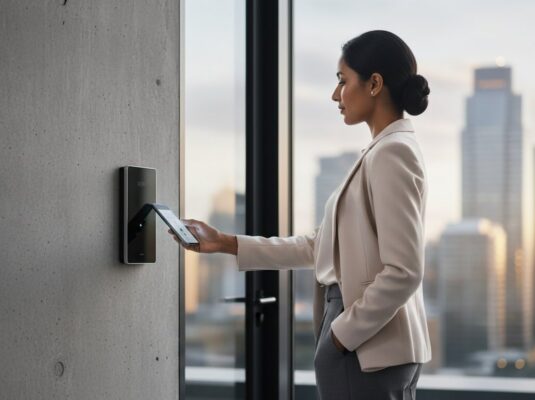
Access Control Systems London: The 2026 Guide to Commercial Security
That growing collection of keys isn’t just a hassle. It’s a direct threat to your London business.
An MLA-approved locksmith offers a crucial advantage. We are masters of both the electronic system and the physical lock it controls. A general security firm might install the electronics but overlook a weak door frame or an unsuitable lock mechanism. As Master Locksmiths Association members, we are vetted, qualified, and guarantee our work. We ensure your entire door set-lock, frame, and electronics-is a single, solid line of defence for your business. This integrated approach is a hallmark of top-tier providers globally, and firms like Easter’s Lock & Security Solutions exemplify this by combining deep locksmith expertise with modern security technology.
You’re tired of paying upwards of £500 to rekey a floor every time an employee leaves. You’re frustrated by the sheer complexity of managing who has access, especially in multi-tenant buildings. It feels like you’re always one lost key away from a major security breach, and the old lock-and-key system simply isn’t keeping up.
This 2026 guide is your solution. We’ll show you exactly how the right access control systems London businesses are now using can eliminate physical keys, provide a complete audit trail of every entry, and integrate seamlessly with your existing MLA-approved high-security locks. We’ll break down the technology, the real-world costs, and the critical steps for future-proofing your commercial property’s security for good.
Key Takeaways
- Discover why traditional keys are a security liability for London businesses and how to efficiently move beyond them.
- Identify which access control systems London premises require, from simple stand-alone units to fully networked solutions.
- Learn how to balance electronic convenience with MLA-approved physical locks for a truly robust security setup.
- Get sector-specific advice for protecting your assets, whether you run a high-traffic City office or an East London retail store.
Why Modern London Businesses are Moving Beyond Traditional Keys
That heavy bunch of keys in your pocket? It’s more than just a hassle. For a modern London business, it’s a significant security liability and a drain on resources. In high-turnover industries from Shoreditch tech startups to West End hospitality, managing physical keys is a logistical nightmare. Every time an employee leaves, you face a critical choice: trust they’ve returned all copies, or pay for a costly rekeying service. It’s a constant, expensive cycle of uncertainty.
Many businesses see Master Key Systems as the solution. They offer tiered access, which is a step in the right direction. But they don’t solve the fundamental problem. A lost master key can compromise your entire building, forcing a complete lock replacement that can easily run upwards of £1,500 for a small commercial property. The hidden costs don’t stop there. Traditional lock maintenance, emergency call-outs for forgotten keys, and the administrative time spent tracking everything add up. In contrast, modern access control systems london businesses are adopting provide a robust, cost-effective alternative that even improves insurance compliance. UK commercial insurers increasingly favour properties with auditable security systems, as they provide concrete data in the event of a claim.
The Security Limitations of Physical Keys
A physical key offers a false sense of security. In London’s 24/7 economy, an unauthorised copy can be made in minutes. Once a key is copied, you have permanently lost control of who can enter your premises. This risk is compounded by the lack of a digital audit trail. With a traditional lock, you have no record of who entered or when. If a theft occurs overnight, you have no data to support an investigation. This is the core weakness that modern systems address. If you’re new to the concept, a good primer on What is Access Control? explains how these systems create a digital record of every entry and exit, providing clarity and accountability that a simple key can never match.
The 2026 Shift Toward Keyless Environments
The future of office security is already here, and it doesn’t require a key. We project that by 2026, the majority of new commercial fit-outs in Central London will prioritise keyless entry. Smartphone-based credentials, using Bluetooth or NFC technology, are becoming the standard. This shift is driven by new working models. With hybrid teams coming in on different days, a physical key is inefficient. A modern access control system allows you to grant access for specific days or times, and revoke it instantly from a central dashboard. This is the flexibility that today’s businesses demand. Furthermore, these systems integrate directly with Building Management Systems (BMS), linking security with efficiency. When the last employee swipes out, the system can automatically turn off lights and adjust the heating, cutting your utility bills without a second thought.
Exploring the Types of Access Control Systems for London Premises
Choosing the right security for your London business isn’t a one-size-fits-all job. The system that works for a small independent shop in East London will not meet the demands of a multi-site corporation in the City. Understanding the core types of access control is the first step to building a robust defence for your property, people, and assets.
Your security needs dictate the technology. Let’s break down the options.
- Stand-alone Systems: One door, one reader, one purpose. These systems are straightforward and cost-effective, perfect for controlling a single point of entry like a stockroom or a private office. They are not connected to a network, with all programming done directly at the door. Simple, effective, and ideal for small businesses needing basic control without a large investment.
- Networked (or PC-Based) Systems: For businesses that need centralised control. A networked system allows you to manage dozens, or even hundreds, of doors across multiple London locations from a single computer. Grant or revoke access instantly, pull detailed audit trails to see who went where and when, and set time-specific permissions. According to a 2023 report from the British Security Industry Association (BSIA), over 60% of new commercial installations are networked for precisely this level of control.
- Cloud-Based Access: This is the evolution of networked control. It gives you the power to manage your security from anywhere with an internet connection. Adjust permissions for your Bow office from a laptop in a cafe, or instantly lock down your Hackney warehouse from your smartphone. It offers unmatched flexibility and scalability, removing the need for on-site servers.
Door Entry vs. Access Control: Knowing the Difference
These terms are often used interchangeably, but they serve different functions. A door entry system, like a video intercom on a residential block in Tower Hamlets, is about vetting unknown visitors before granting entry. Access control is for managing known users, like employees, moving through internal doors to sensitive areas. The most secure London properties combine both for a complete perimeter.
Credentials and Readers
The “key” you use is just as important as the system itself. The choice depends on your required security level and convenience.
- RFID Fobs and Cards: The reliable standard for London businesses. These are durable, affordable, and difficult to duplicate. They operate on proven ISO/IEC 14443 standards, providing a dependable solution for daily use.
- Mobile Credentials: Your smartphone becomes the key. Using Bluetooth or NFC, mobile access offers frictionless entry. A 2024 survey by HID Global found that 54% of organisations plan to adopt mobile access within three years. It’s a modern solution for a fast-paced city.
- Biometric Security: For when security is absolute. Fingerprint, iris, or facial recognition readers offer the highest level of protection because they verify a unique physical trait. High-security London firms, from data centres to financial institutions, rely on biometrics to meet stringent protocols, often aligning with principles found in the UK Government Security Standards.
Selecting the correct components for your access control systems in London is critical. The wrong choice can leave you vulnerable. If you’re unsure which system best suits your premises, our MLA-approved specialists can help. Get a no-obligation security survey today.
Physical Hardware vs. Electronic Access: Finding the Right Balance
A key fob is convenient. A keypad is modern. But neither will stop a crowbar. When installing access control systems London businesses often focus on the digital side and forget the most critical component: the lock itself. Your high-tech system is only as strong as the physical hardware securing your door. Without a robust mechanical foundation, you’re just putting a digital password on a cardboard box.
The truth is, the lock still matters. A lot. We see it every day across London. A business invests thousands in a networked system but pairs it with a standard cylinder that can be snapped or drilled in under 30 seconds. That’s a critical failure. High-security cylinders, like the EVVA 4KS, are designed to resist these brute-force attacks. They provide the physical backbone your electronic system needs to be truly effective. Working with a trusted commercial locksmith London businesses rely on ensures both your physical and electronic security components are correctly specified and installed together.
Integrating Electronic Access with British Standard Locks
Upgrading to keyless entry shouldn’t invalidate your insurance. Most UK commercial policies require final exit doors to be fitted with locks conforming to British Standard BS 3621. We ensure your electronic solution works with a BS 3621-compliant mortice deadlock, not in place of it. For London’s many historic and listed buildings, “escutcheon” readers can be fitted over existing keyholes, preserving the door’s aesthetic while adding modern access control without compromising security or compliance.
When choosing your locking mechanism, consider its purpose. Is it for a high-traffic main entrance or a secure internal office?
- Magnetic Locks (Maglocks): These use a powerful electromagnet to hold a door shut, often with a holding force exceeding 545kg. They are “fail-safe” (unlocking when power is lost), making them suitable for emergency exits. However, they require constant power to remain locked.
- Electric Strikes: An electric strike replaces the door frame’s standard strike plate. It can be configured as “fail-safe” or “fail-secure” (remaining locked without power). They are more discreet than maglocks and often a better fit for internal doors or buildings where aesthetics are a priority.
Fail-Safe vs. Fail-Secure: Life Safety in London
Understanding this difference is not just about security; it’s about life safety. During a power cut or fire alarm, a fail-safe lock will automatically unlock, allowing free egress. A fail-secure lock will remain locked, trapping people inside. The London Fire Brigade, enforcing The Regulatory Reform (Fire Safety) Order 2005, requires that final exit doors on an escape route must not be locked or fastened in a manner that they cannot be easily and immediately opened by any person who may require to use them in an emergency. This almost always means a fail-safe mechanism, often paired with a manual override like a push bar compliant with BS EN 1125.
To prevent a simple power cut from leaving your building vulnerable, we install uninterruptible power supply (UPS) battery backups. These systems guarantee your access control systems London premises remain secure and operational for hours, ensuring security continuity 24/7.
This is where a true locksmith’s expertise is vital. An IT contractor can wire a reader, but an MLA-approved locksmith understands the mechanical engineering of the lock, fire safety regulations, and insurance requirements. We don’t just install a system; we secure your building from the inside out, ensuring every component, digital and physical, works to keep you safe.
Sector-Specific Security: Tailoring Access Control for Offices, Retail, and Residential
A corporate headquarters in the City doesn’t face the same threats as a boutique in Hackney or a residential block in Islington. Your security can’t be off-the-shelf. It must be tailored to your precise environment, your people, and your daily operations. A one-size-fits-all approach is a security failure waiting to happen. We understand the unique pressures of London’s diverse sectors and install systems that work for you, not against you.
From managing the constant flow of people in shared workspaces to securing high-value stock, the right system provides more than just a locked door. It provides control, data, and peace of mind. For residential blocks, modern fobs and readers eliminate the risk of copied keys for communal doors and bin stores, a common issue targeted by opportunistic thieves. For co-working spaces, we create flexible, time-based access. A freelancer’s pass can be programmed to work only from 9 am to 6 pm on their booked days, preventing unauthorised after-hours entry.
Access Control for the London Office
In the high-density financial districts of Canary Wharf and the City, where over 540,000 people commute to work daily, managing who comes and goes is a primary security function. Our systems streamline this process. We can integrate access credentials with meeting room booking software, so a fob or phone can unlock a room only for the duration of a scheduled meeting. This prevents booking clashes and unauthorised use of private spaces. We also create clear, tiered access levels. A junior employee’s pass won’t open the server room, but the IT Director’s will. For complex office environments with multiple departments and security zones, a master key system design London approach can complement electronic access control by providing mechanical backup and hierarchical access to different areas. Crucially, integration with HR systems means access is automatically granted on a new starter’s first day and revoked the moment an employee leaves, closing a common security loophole that, according to the Centre for the Protection of National Infrastructure, is a key factor in insider threat incidents.
Retail and Hospitality Solutions
Your sector has unique challenges. We have specific, MLA-approved solutions. For a detailed assessment of how a tailored access system can secure your London premises, get your free, no-obligation security survey today. We provide guaranteed work with no call-out charge.
Implementing Your Access Control Strategy with an MLA-Approved London Partner
Choosing the right technology is only half the battle. The success of your security system hinges on the partner you choose for installation and support. A faceless national firm can’t offer the speed or accountability your business demands. You need a local expert who understands London’s unique challenges. You need a Master Locksmiths Association (MLA) approved specialist who guarantees their work.
At London Locks, we are that partner. Our roots are firmly in East London. Based in Bow, E3, our team provides rapid response across the capital. When a system fails or you need urgent assistance, we’re not hours away; we’re minutes away. For call-outs in Central London, we bypass the gridlock on our eco-friendly e-cargo bikes. This means we can often reach sites within the Congestion Charge zone faster than a van, ensuring your security is restored without delay. It’s a smarter, faster, and greener approach to London security.
Our MLA approval is your guarantee of quality. It means every one of our locksmiths has been vetted, inspected, and proven to meet the highest standards in the industry. There are no shortcuts, just professional, reliable service from a family-run business that takes your security personally.
Our Professional Site Survey Process
A successful installation starts with a meticulous plan. Our site survey is a comprehensive security audit, not a sales visit. We methodically inspect your property to identify vulnerabilities you may have overlooked. We’ll assess everything from perimeter access points to the integrity of internal doors. Our process includes:
- Weak Point Analysis: We identify high-risk areas, such as unmonitored fire exits or ground-floor windows, that could compromise even the best access control systems in London.
- Hardware Compatibility Checks: We assess your existing doors, frames, and locks. Our survey confirms if your current hardware can support electronic strikes, maglocks, or motorised bolts, preventing costly surprises during installation.
- Transparent Quotations: After our assessment, you receive a detailed, itemised quotation. There are no call-out charges and no hidden fees. The price we quote is the price you pay. Guaranteed.
Ongoing Support and Maintenance
Your security is not a one-time transaction. Electronic systems require professional upkeep to remain effective and secure. We provide a complete support package to give you total peace of mind. A system glitch at 3 AM can leave your premises vulnerable. That’s why we offer 24/7 emergency support for all our clients. A quick call and a local engineer is on their way.
Regular maintenance is critical. We perform scheduled hardware checks to test lock integrity and battery backups. Crucially, we manage all firmware updates for your system. These updates often contain vital patches for newly discovered security vulnerabilities, and failing to install them is like leaving a digital door unlocked. We handle it all, so you can focus on your business. Don’t leave your security to chance. Secure your London business with an expert site survey today.
Secure Your London Premises for 2026 and Beyond
Traditional keys are no longer enough for a modern London business. As we’ve covered, the future of commercial security is about intelligent control: knowing who has access, at what times, and to which areas. A tailored system, whether for a busy office or a high-value retail space, is your first line of defence against evolving threats.
Implementing this technology correctly is critical. For expert installation of access control systems london, you need a partner with proven credentials. London Locks is a family-run business based right here in Bow, London. As an MLA Approved Company, our work meets the highest industry standards. We stand by our transparent service, which is why we have a strict No Call-Out Charge policy. Your security assessment should be honest, not expensive.
Don’t leave your property’s security to chance. Request a professional access control survey from London Locks today and build a safer future for your business.
Frequently Asked Questions
How much does an access control system cost to install in London?
A basic, single-door standalone system in London starts from around £500. For a medium-sized office with 10 doors, a networked system typically costs between £5,000 and £10,000. The final price depends on the number of doors, the type of readers (keypad, fob, or biometric), and the complexity of the wiring. We provide a clear, no-obligation quote with no hidden fees, so you know the exact cost upfront. Your security investment should be transparent.
Can I install access control on a listed building in London?
Yes, but it requires careful planning and official consent. You must obtain Listed Building Consent from your local London council before any work begins. The focus is always on minimal intervention. This often means using wireless systems to avoid damaging historic fabric with new cabling. Our MLA-approved locksmiths have the expertise to design and install systems that respect the building’s character while meeting modern security needs, working within the strict guidelines set by Historic England.
What happens to my electronic locks during a power cut?
Your locks will either remain locked or unlock, depending on their setup. Locks on critical fire escape routes are “fail-safe,” meaning they automatically unlock to allow safe exit. High-security doors are “fail-secure,” so they stay locked to protect assets. Most professional systems include a battery backup (UPS) that keeps everything running for 4-8 hours, giving you plenty of time to manage the situation without compromising your building’s security.
Is an MLA-approved locksmith better than a security company for access control?
An MLA-approved locksmith offers a crucial advantage. We are masters of both the electronic system and the physical lock it controls. A general security firm might install the electronics but overlook a weak door frame or an unsuitable lock mechanism. As Master Locksmiths Association members, we are vetted, qualified, and guarantee our work. We ensure your entire door set-lock, frame, and electronics-is a single, solid line of defence for your business.
Can I use my smartphone to open my office doors?
Absolutely. Modern systems allow you to use your smartphone as a digital key. Using technologies like Bluetooth (BLE) or NFC, access credentials can be sent directly to an app on your phone. This makes managing access incredibly efficient. You can grant or revoke entry permissions remotely in seconds without ever needing to handle a physical fob or card. It’s a secure and convenient way to control who enters your London premises.
How long does it take to install a networked access system for a medium-sized office?
A typical 10-door networked system installation takes our team between 3 to 5 working days. This timeline can vary based on factors like the building’s structure, the type of doors, and the extent of wiring required. We work efficiently to minimise disruption to your business operations. Our goal is to get your new system up and running correctly and quickly, ensuring your property is secured without unnecessary delays.
Are electronic access systems compliant with UK fire safety regulations?
Yes, when installed by a qualified professional. A compliant system must meet the requirements of the Regulatory Reform (Fire Safety) Order 2005. This means all designated fire exit doors must be fitted with “fail-safe” locks and a green break-glass unit to ensure they release in an emergency. When you choose us to install your access control systems London, we guarantee full compliance with all British Standards, keeping your staff safe and your business legal.
Disclaimer
Article written with assistance of AI – any content herein may not share the views or opinions of the company. Please contact the company directly for clarity on any issues with content.